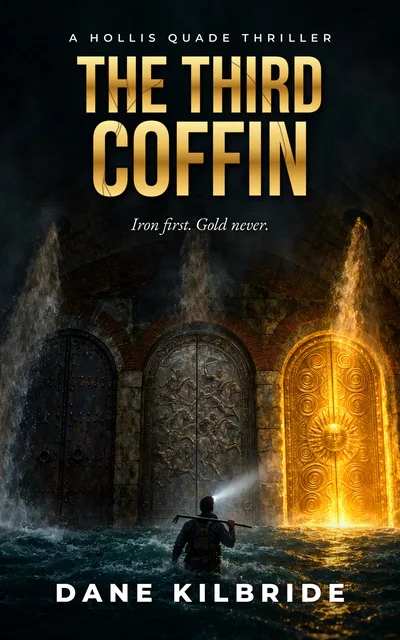
The Third Coffin
Iron first. Gold never.
Hollis Quade spends his days pulling Second World War bombs out of the drought-stricken Danube. The former Army bomb-disposal tech is deaf in one ear, done with war, and still running from the Mosul tunnel collapse that killed his best friend. Then the woman he walked away from seven years ago shows up with a photograph: a Roman stone, exposed by a dying Hungarian lake, signed by the slave engineer who built Attila the Hun’s lost tomb.
A day later, her father is dead.
His killers serve the Mandate, an 800-year-old secret society that collects the objects that made men kings. They want the Sword of Mars, the blade that convinced Attila he was born to rule the world. A Russian black-ops colonel wants it too. But the tomb beneath Lake Tisza isn’t a grave. It’s a machine: three sealed chambers of iron, silver and gold, built by a vengeful Roman to drown anyone who opens it wrong.
Then the Mandate blows the dam that holds back the lake. A hundred square kilometres of water is draining toward a city of seventy thousand, and Quade has one night.
Coming soon to Amazon (Kindle, Kindle Unlimited and paperback). Join the newsletter to hear the day it’s out.
Join the newsletterRead the next one earlyPrologue · The Burial
The Great Plain, beside the river Tisia · the spring of the year 453
The river was gone.
Felix had lived thirteen years, the last four of them as a slave of the Huns. He had watched men flayed. He had watched a city burn so bright that the night glowed orange from one horizon to the other. But until tonight he had never watched anyone steal a river.
What was left of it lay below him in the torchlight: a long, gleaming curve of mud where the Tisia had flowed that morning. Fish flopped in the puddles and eels writhed like black ropes. Upstream, where the river should have come sweeping round the bend, a wall stood across the channel.
A wall of oak.
Two thousand slaves had sharpened two thousand trunks and driven them into the riverbed, then packed the gap behind them with clay, brushwood and stones. The wall stood higher than three men. Behind it the river had turned aside, sulking and brown, into a new channel the slaves had spent forty days digging across the meadow.
Felix had helped build that wall. He had carried clay in baskets until his shoulders bled, and he understood exactly how it worked, because the man who had designed it had made him learn.
“Pressure,” Marcellinus said beside him. “Everything is pressure, boy. Water wants to go home. Your job is to tell it where home is.”
The engineer was old, fifty or more, a Roman of Sirmium, captured when Felix was still sucking his thumb. He had a soft voice, a bent back, and hands that could draw a perfect circle in the dirt without a compass. The Huns called him the Water-Talker and were a little afraid of him, which was the only reason he was still alive.
Felix doubted that would last past tonight.
Down on the dry riverbed, the Huns were singing.
This was no drunken camp song. It was older and stranger, a chant that rose and fell like wind over grass. Horsemen rode in circles around a tent of white silk, faster and faster, their hooves throwing up wet clods, and every few beats they howled the name of the man inside.
Attila. Attila. Attila.
The Scourge of God was dead.
He had died three nights ago, on the night of his wedding to a Germanic girl with yellow hair. Blood from his nose, the slaves said behind their hands. The greatest king in the world had drowned in his own blood while drunk, and in the morning his bride had been found weeping beside him, and for an entire day nobody had dared to touch either of them.
Then the mourning began. The warriors slashed their own cheeks so that their king would be wept for in blood, not tears. They feasted and wept and feasted again, and called it the strava. Now, in the secrecy of the night, they were going to bury him.
In the bed of the river.
So that no one, ever, would find him.
“Look,” Marcellinus murmured.
They were bringing out the coffins.
Felix had watched the smiths make them and hammer on the bands. They came out of the silk tent one after another, each on the shoulders of eight warriors. First came a coffin bound in iron, for the nations Attila had crushed. Then one bound in silver, and last one bound in gold, shining like a second sun in the torchlight, for the tribute of the two empires that had paid and paid and paid to keep the Huns from their gates. The Huns would sing for a hundred years that their king lay in three coffins, one within another, like a nut in its shell.
…continued in the book.
- What kind of book is it?
- A fast archaeological action thriller: real history (Attila the Hun, the Tisza river, Roman engineering) with an invented secret, ancient traps and a race against a flood. Readers of big cinematic adventure thrillers should feel at home.
- Is it part of a series?
- Yes. It’s Book 1 of the Hollis Quade thrillers, and it’s a complete story with a satisfying ending. The Twelfth Hold is next.
- Content guide
- Action violence and peril, occasional strong language, no sex scenes.
- How long is it?
- About 88,000 words (roughly 300 paperback pages).